

Process management of the service company PC "Volkhovets" at SILA Union
Organization of process management for a service company (ACTS – accredited technical service center of Volkhovets PC LLC)
Abstract
The ACTS, which provides customer service to a major manufacturer of interior doors, Volkhovets LLC, faced a systemic management crisis: missed deadlines, a lack of transparent processes, and unmanageable fluctuations in demand. In 2025, the team implemented a comprehensive process management model—from an initial audit and process landscape development to the regulation of key processes and the launch of a KPI system based on a balanced scorecard. The result was a 35% reduction in service delivery times, a nearly halved reduction in customer complaints, increased operational resilience, and the creation of a scalable platform for business development. This project is a story of how a mid-sized service business, lacking a mature process management culture, made it the foundation of its operations in a single project cycle.
Introduction
ACTS is a customer service company founded in 1993 and one of Russia's largest manufacturers of premium interior doors. The company provides a full range of technical services to end customers, including measurements, delivery, installation of door assemblies, panels, and furniture, and technical supervision of the work of its clients' contractors. The ACTS project was launched in Moscow and the Moscow region, employing approximately 35 people and generating a gross profit of 70 million rubles.
At the start of the project, the company's business processes were still in their infancy: operations were largely ad hoc, without formalized regulations, a system of measurable indicators, or a unified work standard.
Business Context
The interior door manufacturing market places high demands on technical service: quality measurements, speed of delivery, and professional installation directly shape customer loyalty and brand reputation. ACTS occupied a critical position in this chain, but was unable to systematically manage its operations: transparent interaction chains, key performance indicators, and control points were lacking.
Specific pain points were identified in the problem area and identified at the outset:
- Regular delays in service delivery deadlines across all areas;
- Inconsistency between departments (MRK and MTS operated without uniform standards);
- Lack of control over fluctuations in market demand—the company was unable to adaptively reallocate resources;
- Rapid business growth without parallel development of the management system led to functional disunity;
- Insufficient automation of operations despite high task volumes.
In addition to operational challenges, the company experienced financial instability: from November 2024 to July 2025, profitability was predominantly in the critical zone (below 5%), and in January 2025, the company posted a loss (-11%) due to an increased tax burden.
The founders' strategic goal was to create a manageable, adaptable service structure capable of scaling to new regions and consistently delivering a high-quality customer experience consistent with the brand's positioning.
Business Process
The project's target is the four core service processes of the ACTS, which form an end-to-end value chain for the client: Measurement → Delivery → Installation → Claim Processing. These processes cover the entire lifecycle of interactions—from the specialist's first contact with the client to the closure of the claim. In the company's architecture, they are classified as core processes; management and support processes (HR, finance, IT, contractor management) are included within the perimeter as supporting processes.
Project Participants and Team:
Project Sponsor — The Founder of the ACTS, who approves strategic decisions, budgets, and organizational changes.
Project Manager and Implementer — K.S. Prokopenko, who coordinated the working groups and was responsible for ensuring our project was completed on time and with the desired results. He coordinated the team, resources, communications, and risks throughout the entire project, from initiation to closure. The project's methodologist was business analyst D.S. Savkina, who ensured the intelligent design of the management system by developing a process landscape, a strategy map, and implementing BPMN 2.0 notation, as well as by ensuring the project's methodological integrity.
The project auditor, M.A. Terekhova, provided expert oversight of the designed business processes' compliance with financial, accounting, and HR legislation.
The project team included the head of the measurement, delivery, and installation department, service specialists, and employees from related departments. The company's talent pool was actively utilized during the project's implementation: the CEO was appointed from the talent pool.
Stakeholders included approximately 30 company employees, external contractors, dealers, and end customers (B2C and corporate clients).
The process team's goals—ensuring deadlines across all service areas, standardizing the company's work, and creating a measurable quality management system—were directly derived from the company's strategic priorities: manageability, adaptability, and readiness for scalability.
Innovation
The key innovation of the project was not the use of new technologies, but rather the fact that a service company operating in the traditionally manual B2C segment consistently applied a set of mature BPM methodologies in conjunction: BPMN 2.0 + Process Landscape + Problem Field + Balanced Scorecard + KPIs + PDCA + RACI – creating an integrated, turnkey management system where nothing existed before.
Several solutions deserve special attention:
One of the key features of the project was a lean approach to investment: we deliberately avoided the implementation of expensive, cumbersome ERP systems and the bloating of staff. The primary focus was on the coordinated application of process management methodology and the use of flexible cloud tools (Planado), which enabled us to achieve a significant increase in efficiency with minimal investment.
"As-is" comparative analysis: Instead of imposing a single standard from above, the team identified differences in how different employees implemented the same processes. After identifying the causes and conducting an analysis, they selected the best and most adaptive version of each process as a basis. This allowed them to create a standard that was accepted by employees, rather than rejected.
Parallel implementation without waiting for a complete description: processes were implemented simultaneously with their refinement – iteratively, with 3-4 adjustments to each process before and after implementation. This reduced the gap between design and results.
Developing a positive employer image as a management tool: First and foremost, we eliminated excessive requirements (mandatory video recording of unpacking), the "Refer-a-Friend" program, and reduced the cost of errors for contractors – all of this built trust and loyalty among external service providers (service specialists). When tax legislation changed, contractors accepted the reduction in income with understanding – a rare result.
Separating processes by area while maintaining employee versatility: The reorganization of the MRK and MTS departments along the "Measurement - Delivery - Installation - Claims" principle allowed us to identify and leverage the strengths of each specialist without compromising their cross-functional flexibility.
Challenges
The main lesson of the project: systemic changes don't work if they are implemented from above without the involvement of those directly involved. That's why meetings with service specialists to discuss and improve their processes were made regular, and the employees themselves became co-authors of the standards.
Specific challenges and ways to overcome them:
Resistance to change among contractors: This was addressed by creating tangible and intangible incentives—reduced penalties for errors, a "refer-a-friend" program, and a comfortable office environment. Trust in contractors became a management decision, not a concession;
Lack of an automated monitoring framework: During the implementation phase, monitoring was carried out manually through reports, which created a burden on the analyst. Requirements for automated reports were developed in parallel, which prevented the process from being interrupted due to IT limitations;
Difficulty in digitizing goals: Some goals in the strategic map require more precise numerical indicators and deadlines. This is the project's area for further development.
We recommend that organizations implementing BPM: don't wait for the process description to be fully developed—involve employees in defining the problem space, begin implementing what's already understood, integrate and document the results, and celebrate employees' small victories as they achieve results. A vibrant, working process with subsequent adjustments is more effective than a perfect, unreadable regulation.
Results
The main achievement of the ACTS project is that a company with manual, opaque management has transformed itself into an organization with measurable processes, stable standards, and a culture of continuous improvement.
Operating results (as of December 2025):
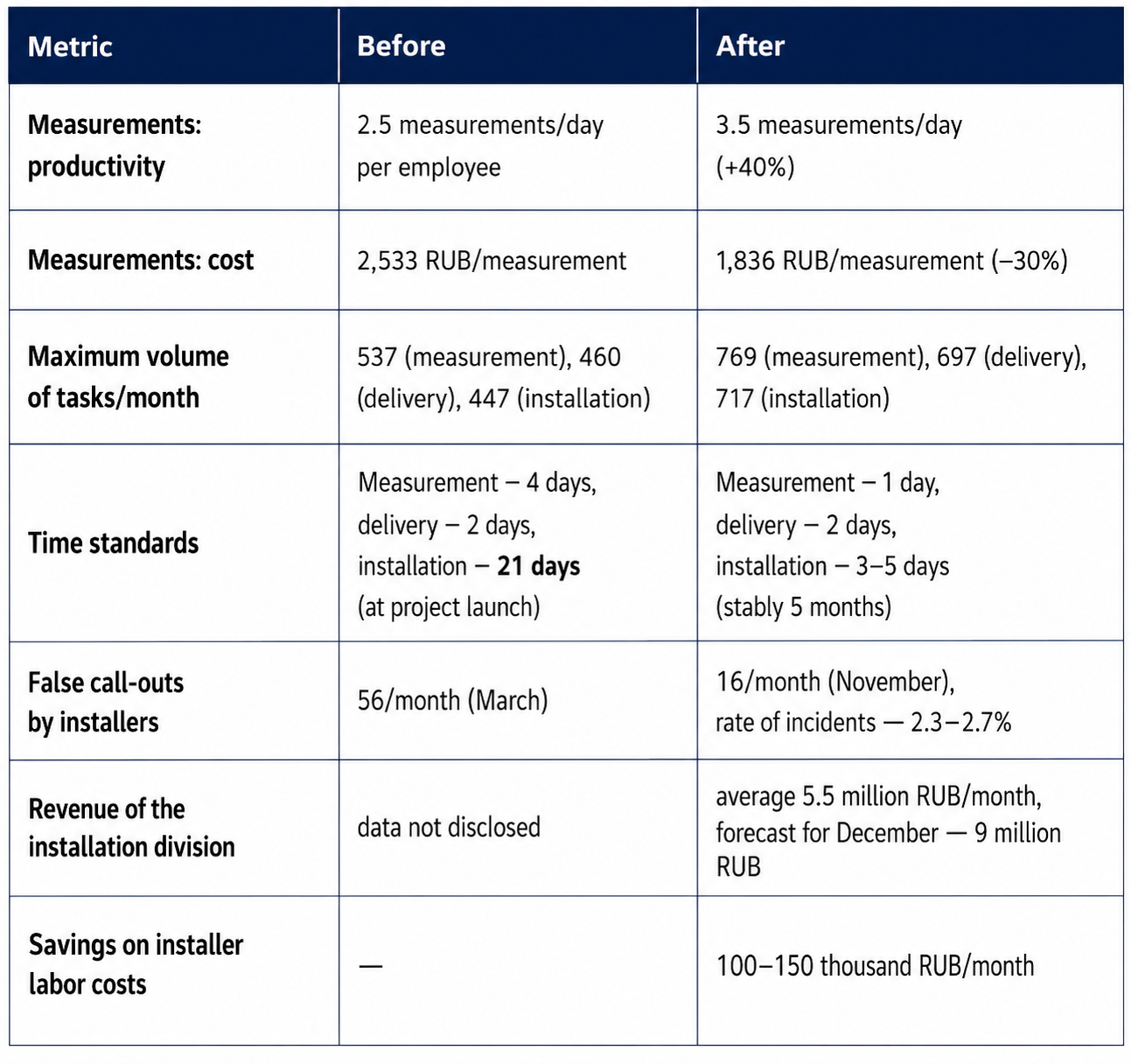
Overall project impact:
- 35% reduction in service delivery times;
- 47% reduction in customer complaints;
- Increased NPS and customer satisfaction;
- In 2025, the reason for layoffs due to "poorly structured service processes" has been completely eliminated—employees no longer leave due to operational chaos;
- A scalable platform has been created: the established process landscape, regulations, and KPI system are applicable as ACTS expands into new regions.
- The financial situation has stabilized: after the crisis in January 2025 (losses of -11%/-16%), the contractor payment structure was revised, offsetting the increased tax burden.
Information Technology
The following information technology tools were used in the project:
Bitrix24 — a business process approval and storage system (knowledge base): it handled process setup tasks, process approval with department owners and managers, and the final deployment of regulations;
Planado — a tool for automating task distribution for the measurement and delivery service: it optimized routes, increased route density from 2.7 to ~4 measurements per day, and created a 20% productivity reserve;
CRM — used to manage customer requests and process claims; in terms of the claims process, automation was deemed insufficient and required improvement;
SILA Union — used for corporate architecture design (replaced Business Studio in February 2025 as a system that better met the company's requirements);
Management dashboards — tools for monitoring KPIs across four BSC perspectives; At the end of the project, the systems are operating in a semi-automated mode, with the potential for full automation.
The key IT objective for the next period is the development of a specialized application for automated claims processing in the CRM system, including a separate channel for designers and clients with the ability to submit data online.
Partner
The most significant contributions to the project's success were made by:
Experts and employees of Volkhovets PC LLC and dealers were involved as members of working groups, providing expertise on the product and related interaction processes.
Business Set - methodological support and use of the modeling environment (SILA Union)
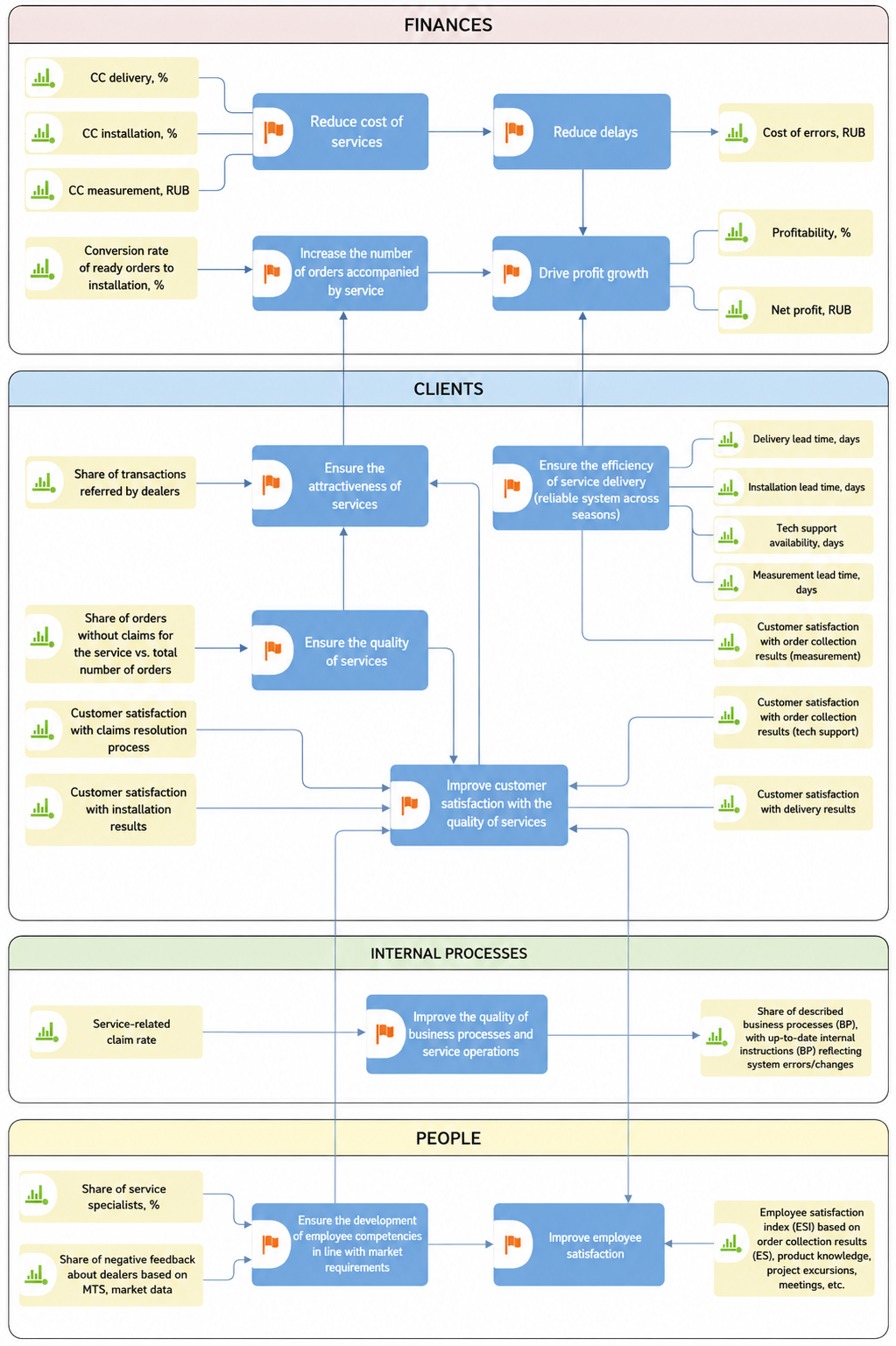
Fig. 1. Using SILA Union software in the Volkhovets PC LLC project